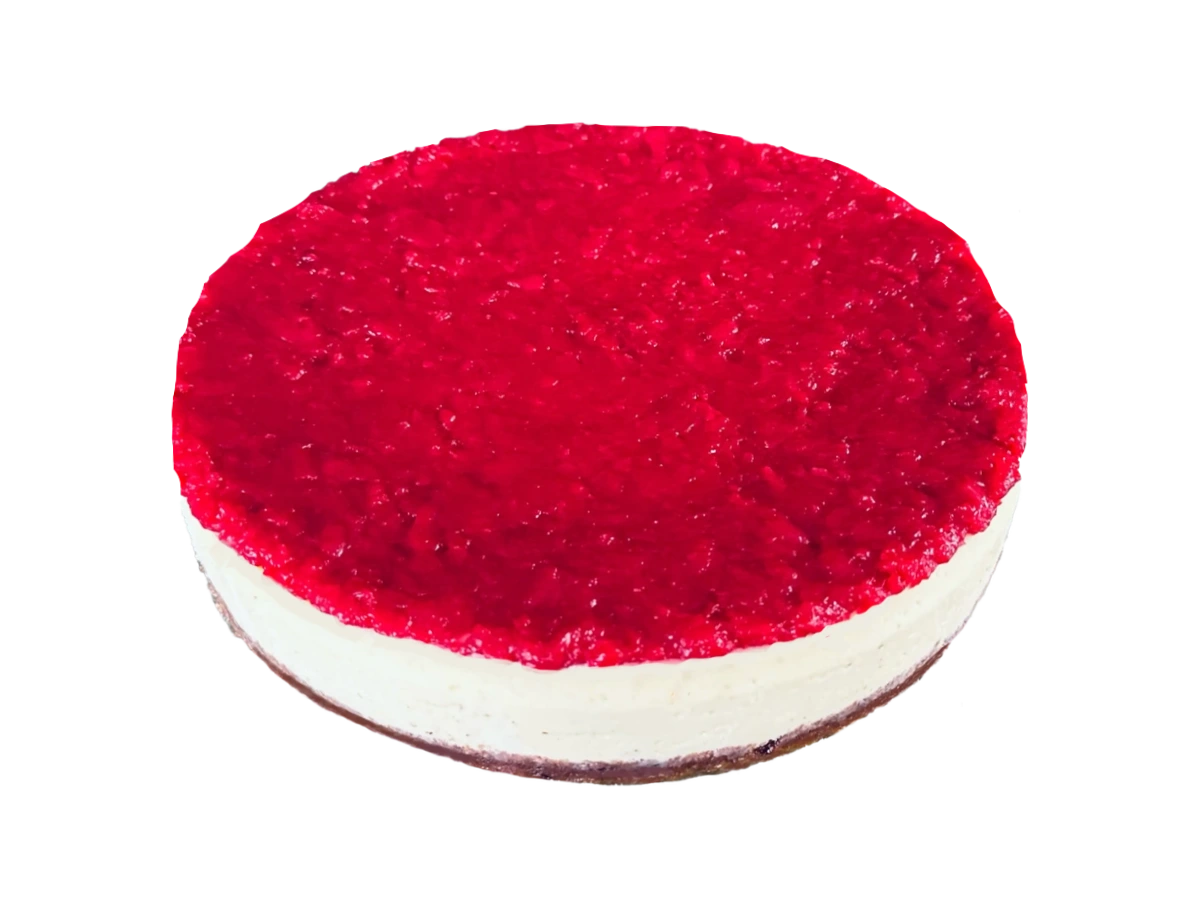
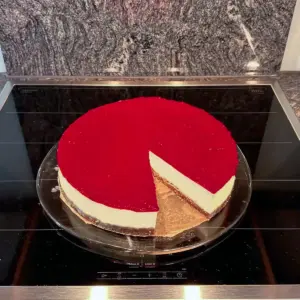
New York Cheesecake is a classic of New York baking tradition. Smooth cream cheese filling, a fine cookie crust and a fruity topping combine in its characteristically rich flavor.
Rezept drucken
Auf Pinterest speichern
Portionen: 12
Nutrition Facts
Raspberry New York Cheesecake Recipe
Serving Size
1 Slice
Amount per Serving
Calories
598
% Daily Value*
Fat
38.8
g
60
%
Saturated Fat
22.8
g
143
%
Sodium
392
mg
17
%
Carbohydrates
52.8
g
18
%
Fiber
3.9
g
16
%
Sugar
35.8
g
40
%
Protein
10.4
g
21
%
* Percent Daily Values are based on a 2000 calorie diet.
Rezept bereits ausprobiert?Danke für deine Bewertung.
Utensilien
- Electric hand mixer
- 2 Offset spatulas (stainless steel)
- Springform pan (26 cm / 10-inch diameter)
- Silicone scraper (about 30 cm / 12 inches long)
- Stainless steel cake lifter (about 28 cm / 11 inches wide)
- Digital kitchen scale (with tare function, up to 5 kg / 11 lb)
- Whisk
- Lemon zester
- Freezer bag (for crushing the whole-wheat butter cookies)
Zutaten
Cheesecake crust
- 200 g Whole-wheat butter cookies (about 7 oz)
- 100 g Butter (about 7 tbsp, just under ½ cup)
- 25 g White sugar (about 2 tbsp)
- 1/2 tsp Salt
- 20 g Ground almonds (about 3 tbsp)
Cheesecake filling
- 800 g Cream cheese (about 3½ × 8 oz blocks)
- 250 g White sugar (about 1¼ cups)
- 75 g Cornstarch (about ½ cup plus 1 tbsp)
- 1 tsp Vanilla paste
- 1 Organic lemon (finely grated zest)
- 6 Eggs (medium to large)
- 600 g Sour cream (about 2½ cups; alternative: crème fraîche)
- 1 tsp Lemon juice
Cheesecake fruit topping
- 400 g Frozen raspberries (about 14 oz or 3 cups; alternative: blueberries)
- 35 g White sugar (about 3 tbsp)
- 1 tbsp Lemon juice
- 1.5 tbsp Cornstarch
Anleitungen
Cheesecake crust
- Line the base of the springform pan with a sheet of parchment paper, clamping it firmly between the base and the ring. Trim any overhanging paper with scissors, then lightly grease the sides of the pan.
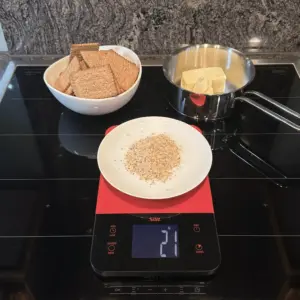
- Melt the butter. Add it to the cookie crumbs, sugar, ground almonds, and salt, then mix in a bowl until everything is evenly combined and the crumbs are well moistened.
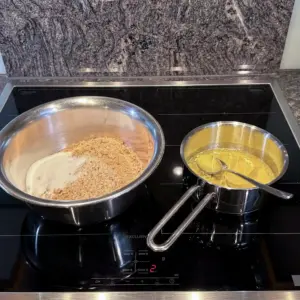
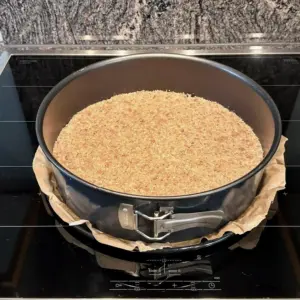
- Transfer the crumb mixture to the prepared pan and press it down very firmly with the back of a spoon to form an even base. Preheat the oven to 175°C / 350°F (conventional, non-fan oven) and pre-bake the crust for about 10 minutes. Remove from the oven and let it cool briefly.
Cheesecake filling
- Add the cream cheese, sugar, cornstarch, vanilla paste, finely grated lemon zest and 1 tsp lemon juice to a bowl and mix carefully until smooth. Add the eggs and sour cream and stir gently until just combined; do not whisk or beat the mixture until fluffy. Increase the oven temperature to 225°C / 435°F using conventional heat without the fan. Place a high-rimmed baking tray on the lowest rack and fill it with about 1–2 cm / 1/2–3/4 inch of water to create a moist baking environment.
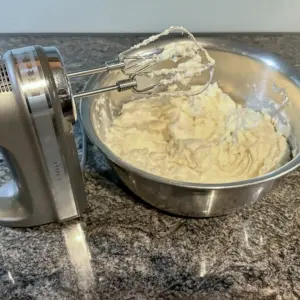
- Pour the cheesecake filling onto the pre-baked crust in the springform pan and smooth the surface. Place the springform pan on the rack directly above the water tray and bake for 10 minutes at 225°C / 435°F. Then reduce the temperature to 100°C / 212°F and bake for about 50 minutes more, until the center still jiggles slightly. During the final 30 minutes, loosely cover the cheesecake with parchment paper or aluminum foil. Turn off the oven and let the cheesecake cool inside for 2 hours with the oven door closed to help prevent cracks in the delicate surface. Remove it from the oven, let it cool briefly at room temperature until it is no longer hot, then refrigerate it overnight until fully chilled.
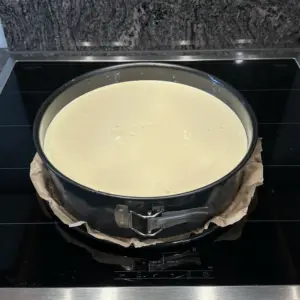
Fruit topping
- Once the cheesecake is fully chilled, carefully remove the springform ring. Allow the frozen raspberries to thaw completely, then press them through a fine-mesh sieve so no seeds remain in the topping. Place the raspberry purée in a saucepan with the sugar and 1 tbsp lemon juice, then bring it to a gentle boil while stirring.
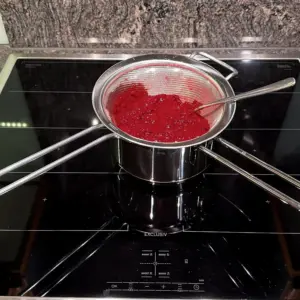
- Stir in the cornstarch that you’ve mixed with a little water, then let the raspberry sauce simmer for 1–2 minutes, stirring constantly, until it thickens slightly. Be careful not to cook it too long—it should stay nicely spreadable, not firm. Let the sauce cool a little, then spoon it onto the fully chilled cheesecake and gently spread it smooth with an offset spatula.
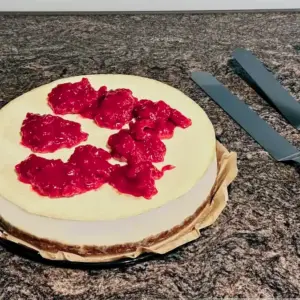
- Using a stainless steel cake lifter, carefully transfer the fully chilled cheesecake, still on the parchment paper, onto a serving plate. Carefully trim away the excess parchment paper around the edge of the cheesecake.
Notizen
The fruit topping should be thick enough to spread without running, but not so firm that it damages the delicate cheesecake surface when applied. Let the sauce cool briefly and, if needed, carefully loosen it with a small amount of water or fruit juice. For a smooth raspberry topping, press the raspberry purée carefully through a fine-mesh sieve to remove all seeds.
Rezept bereits ausprobiert?Danke für deine Bewertung.