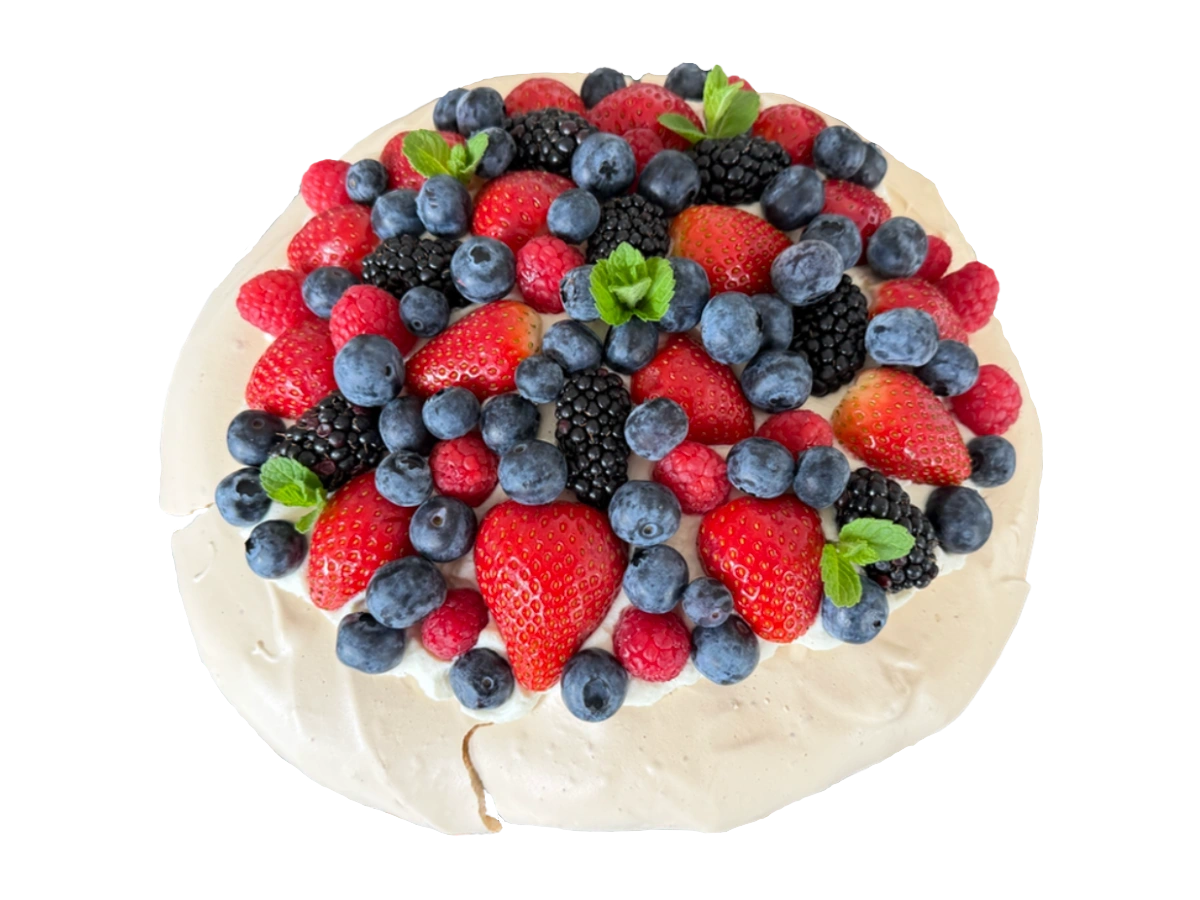
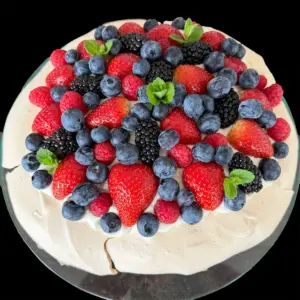
The Pavlova has a fine, lightly crisp meringue shell and a soft, airy centre. Whipped cream, fresh berries and a little mint add colour, freshness and an elegant, festive touch when served.
Print recipe
Save on Pinterest
Servings: 8
Nutrition Facts
Pavlova Cake Recipe
Serving Size
1 Slice
Amount per Serving
Calories
372
% Daily Value*
Fat
13.4
g
21
%
Saturated Fat
8.6
g
54
%
Sodium
90
mg
4
%
Carbohydrates
59.3
g
20
%
Fiber
1.6
g
7
%
Sugar
56.1
g
62
%
Protein
4.6
g
9
%
* Percent Daily Values are based on a 2000 calorie diet.
Already tried this recipe?Thank you for your rating.
Equipment
- Electric hand mixer
- Springform pan (30 cm / 12-inch diameter, using the base only)
- Silicone scraper (about 30 cm / 12 inches long)
- Digital kitchen scale (with tare function, up to 5 kg / 11 lb)
Ingredients
Meringue base
- 7 Eggs (use only the egg whites from large eggs)
- 390 g Sugar (about 2 cups)
- 1 pinch Salt
- 2 tsp White vinegar
- 1 tbsp Cornstarch (lightly heaped)
- 2 tsp Vanilla paste
Cream layer
- 350 g Whipping cream (about 1 1/2 cups)
- 2 tbsp Sugar (granulated sugar)
- 1 tsp Vanilla paste
Berry topping
- 120 g Strawberries (about 4 oz)
- 80 g Raspberries (about 3 oz)
- 70 g Blueberries (about 2 1/2 oz)
- 60 g Blackberries (about 2 oz)
- 5 Mint leaves (very small, optional for decoration)
Instructions
Prepare
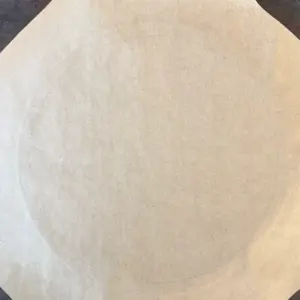
- Line a baking sheet with parchment paper. Draw a 24 cm / 9 1/2-inch circle on the parchment paper, then turn the paper over so the marking does not touch the meringue mixture. The circle is only a guide. The mixture should later be shaped compactly and slightly higher, not spread flat right to the edge. Separate the eggs while they are cold. Then let the egg whites come to room temperature. This helps them whip more evenly. The bowl, whisk and spatula must be completely clean, dry and free from grease so the meringue mixture can whip up properly.
Prepare the meringue base
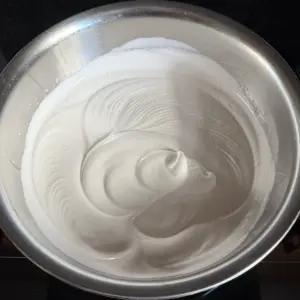
- Place the egg whites and the pinch of salt in a clean, grease-free bowl. Beat on medium speed until an even, foamy base forms and the mixture holds soft peaks. Do not start at the highest speed, as the structure should build evenly and steadily. Add the sugar gradually, preferably one tablespoon at a time or in small portions. Use granulated sugar for this Pavlova. After each addition, continue beating until the sugar is well incorporated into the egg white mixture. This step takes time and should not be rushed. The mixture should be thick, glossy and very firm at the end. It must be stable enough to shape on the parchment paper and should not spread out. To check the texture, rub a little meringue mixture between your fingers. It should feel as smooth as possible and no longer clearly grainy. If many sugar crystals are still noticeable, keep beating until the texture becomes finer. Add the cornstarch, vinegar and Vanilla paste to the meringue mixture and mix in briefly, just until evenly combined. Do not continue beating longer than necessary, so the mixture stays stable and glossy.
Bake and let cool
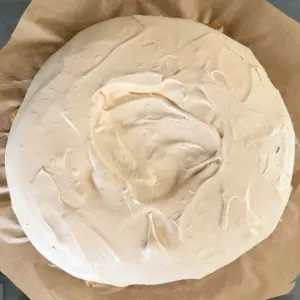
- Preheat the oven to 130 °C / 265 °F using top and bottom heat. Place the Pavlova in the oven and immediately reduce the temperature to 115 °C / 240 °F. Bake the Pavlova for 2 hours 15 minutes. It should stay pale and dry slowly. Keep the oven door closed as much as possible while baking. Pavlova is sensitive to temperature changes. If it takes on noticeable colour, reduce the temperature slightly next time rather than covering the Pavlova while it bakes. After baking, turn off the oven and let the Pavlova cool completely in the closed oven for at least 5 hours. Do not open the oven door during this time. This slow cooling is an important part of the recipe. The crust continues to stabilise while the inside stays soft. Move the Pavlova only after it has cooled completely. It is very delicate while warm and can break more easily. Do not lift the fully cooled Pavlova directly off the parchment paper. Instead, carefully slide the Pavlova with the parchment paper from the baking sheet onto a flat serving plate. Then use small, sharp scissors to trim the excess parchment paper close to the edge. Do not pull on the Pavlova and do not try to pull the paper out from underneath it. A small piece of paper under the Pavlova is not a problem and helps protect the delicate crust from breaking.
Berry topping
- Halve or quarter the strawberries, depending on their size. Leave the raspberries, blueberries and blackberries whole. Check the berries carefully and use only dry, attractive fruit. If the berries are very moist, place them briefly on kitchen paper so the cream and meringue crust do not absorb unnecessary moisture. Add the topping to the Pavlova shortly before serving. Whip the cream with the sugar and Vanilla paste, then spoon it into the centre of the Pavlova. Spread the cream loosely and, if desired, slightly towards the edge. First add the strawberries and blackberries as larger accents. Then add the raspberries and place the blueberries in the gaps. If desired, place 5 small mint leaves between the berries. They add a fresh colour contrast, but should be used sparingly so the berries, cream and meringue remain the focus.
Notes
Target texture
The Pavlova should be dry, fine and lightly crisp on the outside. Inside, it stays soft, airy and delicate, but should not be wet or unstable. When sliced, the crust may crack slightly. The centre should be set enough so that slices can be lifted out carefully.
Tips for a good result
Small cracks in the Pavlova crust are normal and do not affect the result. They form because the outer shell dries and becomes stable while the inside stays soft and contracts slightly as it cools.
If the Pavlova browns strongly, the temperature was too high. If it spreads too much or stays very flat, the mixture was usually not beaten firmly enough or the crust did not have enough time to set.
The unfilled Pavlova should not be stored in the fridge, as it can absorb moisture there. It is better to store it in a dry place at room temperature. Add the topping only shortly before serving.
If the Pavlova browns strongly, the temperature was too high. If it spreads too much or stays very flat, the mixture was usually not beaten firmly enough or the crust did not have enough time to set.
The unfilled Pavlova should not be stored in the fridge, as it can absorb moisture there. It is better to store it in a dry place at room temperature. Add the topping only shortly before serving.
Already tried this recipe?Thank you for your rating.